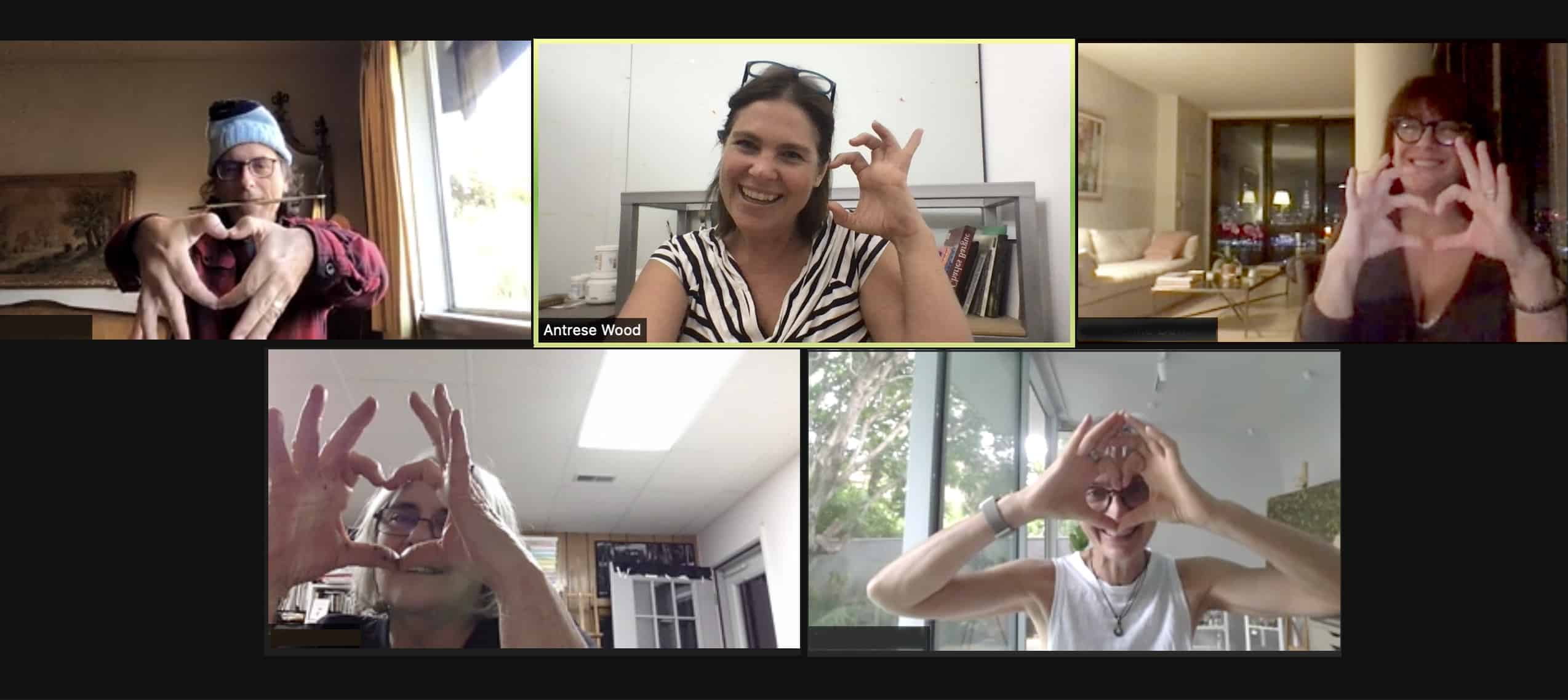
By Antrese Wood, host of Savvy Painter and founder of Growth Studio.
The reason your art practice feels scattered is usually not a discipline problem. It’s a season problem. When you try to make art, share art, sell art, and rest all at once — at equal volume, all the time — you’re not doing all of them. You’re doing none of them well. Knowing which season you’re in is what makes it possible to be fully present in your practice, quiet the noise of everything you think you should also be doing, and actually move forward.
What are the Four Seasons of an art practice?
The Four Seasons framework describes four distinct phases every artist moves through: Making Art, Sharing Art, Selling Art, and Rest. Making is where you create the work. Sharing is where you put it in front of people. Selling is where you invite people to own it. Rest is where you recover so you can do it all again.
These seasons don’t happen simultaneously. They cycle. You move through them. Trying to run all four at full volume doesn’t multiply your output. It splits your focus in a way that pushes you toward what I call the Ring of Terror (the outermost zone of your practice, where the nervous system is so activated that creative thinking, focus, and decision-making all go offline), and you end up busy but ineffective. Active but stuck.
Why is it so hard to choose between the making season and the sharing season?
The Making season and the Sharing season have a particular tension. When you’re in the studio, focused on the canvas, a voice shows up saying you should also be promoting your work, building your audience, being more visible. When you’re in a sharing season — posting, putting yourself out there — the pull is back to the studio.
Most artists end up caught between the two: half-present in one, half-present in the other, fully present in neither. That’s not a failure of discipline. That’s what it looks like when you’re trying to be in two places at once.
What changes when you know which season you’re actually in: the thoughts that belong to a different season stop hooking you. You can evaluate what comes up with more clarity. Some thoughts are relevant to where you are. Some belong to a different time. Once you can tell the difference, you have a lot more room to trust your own choices.
(Being in a season doesn’t mean total blackout on everything else. Think 80/20 — 80% of your energy in your primary season, with small background attention on what’s coming next. The key is knowing what your priority is. That’s what quiets the noise.)
What is the Artist GPS, and why does it matter?
The Artist GPS is a metaphor for orientation. A GPS needs to know where you’re starting from before it can give you a route. Your practice is the same. Knowing your current location — which season you’re in, honestly and without judgment — is what makes navigation possible. Wherever you are is the right place to start from. There’s no wrong location. And once you have that orientation, the information relevant to your season gets louder and clearer, and the information that belongs somewhere else stops pulling at you with the same urgency.
What are the Three Zones, and how do they show up in the sharing season?
The Three Zones describe the emotional terrain of your practice at any given moment. The Circle of Comfort is familiar, safe territory — where you feel capable and at ease. The Growth Zone is just outside that circle, a little uncomfortable but manageable, and that’s where growth actually happens. The Ring of Terror is the outermost zone, where discomfort has tipped into overwhelm and the nervous system is dysregulated.
The Sharing season tends to push artists toward the Ring of Terror — not because sharing is bad, but because the vulnerability of being seen is genuinely uncomfortable. It’s easy to mistake that discomfort for a signal that something is wrong. What I want to offer instead: the discomfort is the terrain of this season. It means you’re in the Growth Zone. The discomfort and the growth are the same thing. When you know that, you can tend to it in a way that keeps you going.
Is it okay to stop making art and rest?
Yes. Completely. Rest is one of the Four Seasons — not a gap between real seasons, not a detour, not something to recover from. It’s a real phase with its own function: recovery, recalibration, and quiet preparation for the next making season.
One of the artists in my community, Hélène, went through a period of heavy family obligations and didn’t paint for about three and a half months. When she came back to her studio, she still wasn’t painting — and the familiar discomfort of that arrived right on schedule. She sat with it. Then she made a decision: she was going to let herself be in a rest season, fully, without a deadline for when she should be back at the canvas. No countdown. No pressure. Just rest.
When she felt recharged and ready, she came back with ten canvases going at the same time. Floodgates. She hadn’t fallen behind during those three and a half months. She was exactly where she was supposed to be. Taking that time to care for the people she loves wasn’t a detour from her practice. It was part of it.
What is a curiosity-led art practice?
Another artist inside Growth Studio, Dinah, had been carrying a story about herself for years: she never finishes a body of work. That story felt like evidence of a flaw — like there was a right way to make art and she was doing it wrong.
What was actually happening: Dinah follows her curiosity. When her interest in a subject runs out, she moves on. When something new sparks her attention, she goes there. That’s not incompletion. That’s a practice organized around curiosity, which is a legitimate and coherent way to work. It just needed a name that honored it as the strength it is.
Over time, she found a different story. She came in one day and said: I follow my curiosity. If it becomes a body of work, great. If it doesn’t, that’s okay too. What changed wasn’t her process. What changed was her understanding of it and her trust in herself. This is what “the noticing itself is the shift” looks like in practice. When Dinah noticed that the story she’d been carrying wasn’t serving her, a small pause opened up. In that pause, she could choose something different. The noticing is what made the choice possible.
How do you tell the difference between being behind and being in a season?
One question worth sitting with: Am I actually behind, or am I in a season? Because those are completely different situations, and only one of them is real.
Behind implies you’ve fallen short of some external standard, that there’s a right pace and you’ve failed to keep up. In a season means you’re in a specific phase of your practice, and your job is to be fully present in it. When you know which is true, the noise quiets. Your path forward gets clearer.
If you’re still working out which season you’re in, there’s a simple orientation guide at savvypainter.com/map. Two or three minutes. No overwhelm. Just your current location.
Your practice is already moving in seasons, whether you’re tracking it or not. The work of the Artist GPS isn’t to force yourself into a season you think you should be in. It’s to get honest about where you actually are, and let that be enough. You’re not behind. You’re somewhere specific. And somewhere specific is always the right place to start from.
Frequently Asked Questions
Why do I always feel like I should be doing more with my art practice?
That feeling usually comes from trying to be in multiple seasons at once. When you’re in a making season but also feel pressure to share, promote, and sell simultaneously, attention splits in a way that makes everything feel insufficient. Identifying which season you’re actually in gives the “not enough” feeling nowhere to attach. You’re doing the right thing for this season, right now.
Is it okay to take a break from painting without feeling guilty?
Yes. Rest is one of the Four Seasons, not a gap between real seasons. Artists who let themselves rest fully tend to return to making with more energy and more ideas than artists who push themselves back to the canvas before they’re ready. The rest season is doing something, even when it doesn’t feel productive.
What is the Ring of Terror in an art practice?
The Ring of Terror is the outermost zone in the Three Zones framework, beyond the Circle of Comfort and the Growth Zone. It’s where discomfort has tipped into overwhelm and the nervous system is dysregulated — in this state, access to creative thinking, focus, and good decision-making shuts down. Artists often hit the Ring of Terror when they try to run multiple seasons simultaneously, or when the discomfort of the Sharing season goes unrecognized and unaddressed.
How do I know which season I’m actually in right now?
Your primary season is where the majority of your energy and focus genuinely lives. If you’re mostly in the studio creating, that’s the Making season. If you’re mostly putting work in front of people, that’s the Sharing season. You can have background attention on other seasons (roughly 80/20), but where your real priority sits tells you where you are. The orientation guide at savvypainter.com/map can also help you locate yourself.
What does “the noticing itself is the shift” mean?
It means awareness interrupts the automatic pattern. When you notice a thought or a story that’s been running on autopilot, a small pause opens up. In that pause, a choice becomes possible. Without the noticing, there’s no pause and no choice — just the same thought running the same pattern. The noticing is what makes something different possible, even before anything else changes.