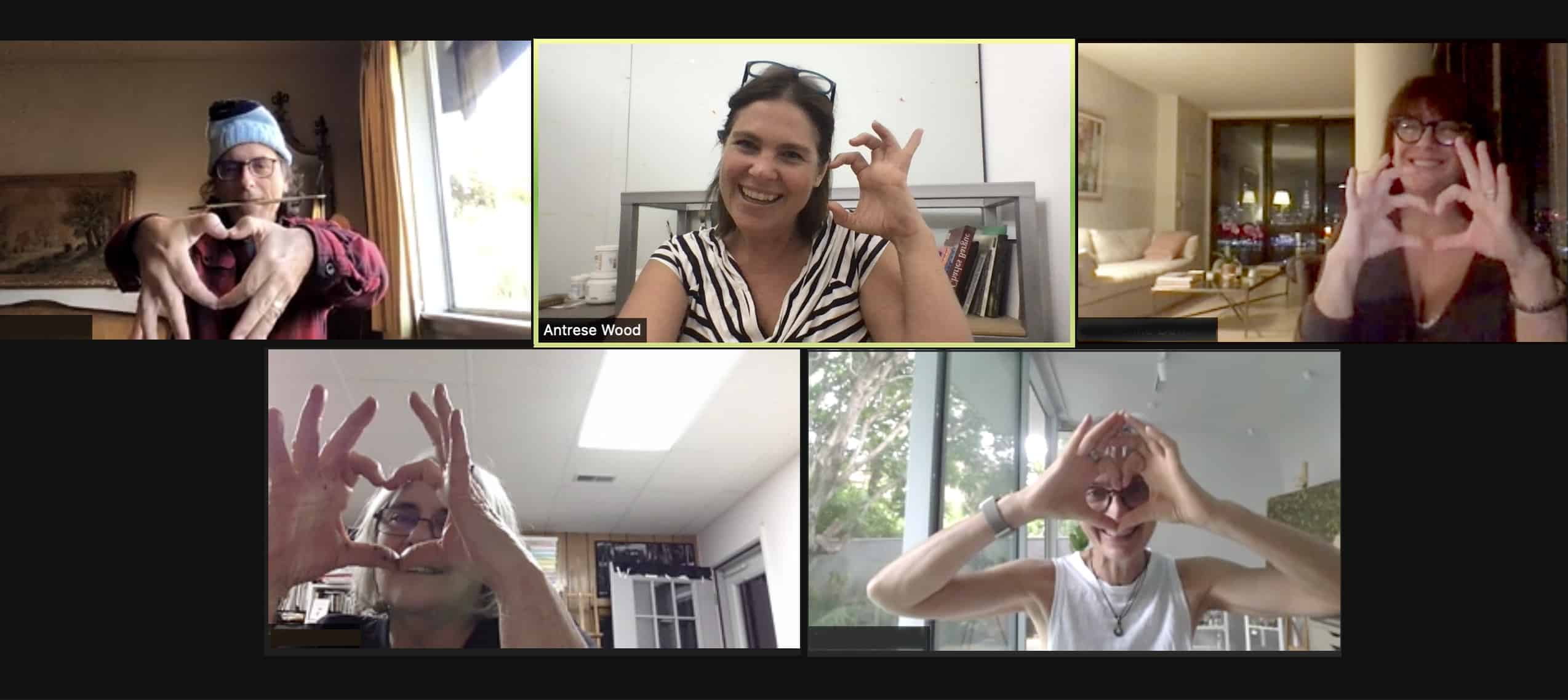
By Antrese Wood, host of Savvy Painter and founder of Growth Studio.
The most powerful move you can make as an artist isn’t fixing your technique or pushing past resistance. It’s noticing. The moment you become aware of a thought pattern that isn’t serving you, you’ve already interrupted it. You’re no longer inside the automatic loop. You’re observing it. And that observation (that tiny pause between the old pattern firing and your response) is where choice becomes possible. That’s what I mean when I say: the noticing itself is the shift.
Why do artists keep running on autopilot?
Our brains are built for efficiency. On average, we have around 60,000 thoughts a day, and about 90% of those are the same thoughts we had yesterday. That means roughly 54,000 thoughts daily are automatic patterns on repeat: the self-doubt, the comparison, the background noise of not-enough.
These patterns aren’t a character flaw. They’re how our brains work. The brain loves shortcuts and predictability, so those automatic thought loops feel like facts. Like just the way things are. And because they feel normal, we don’t think to question them.
Until we start to notice.
What actually happens when you notice a thought pattern?
When you observe a thought rather than just thinking it, you activate a different part of the brain than the one running the automatic response. You can’t simultaneously be inside the reactive pattern and observing it.
That observation creates a pause. And that pause is what I call a choice point — the gap where you can respond differently, or simply meet yourself with more kindness than the automatic pattern would have allowed.
The noticing breaks the circuit. That’s brain rewiring happening in real time, right there in the pause.
Is noticing really a “little big win”?
Inside Growth Studio, I use the phrase “little big wins” to describe moments of awareness that artists tend to underestimate. An artist will start sharing something on a coaching call and pause: “I don’t know if this counts as a win, but I noticed what I was thinking before I reacted.” Every time I hear that, I want to stop her right there. Because that is the win.
The noticing is the mechanism through which everything else changes. Catching yourself in a self-critical spiral, in the avoidance, in the comparison: that’s a hero moment. Not a moment to feel bad about. Proof that you’re no longer running on autopilot.
What does noticing look like in the studio?
One Growth Studio artist, Sheila, was trying to get into her home studio one afternoon when other things kept pulling her away. By the time she had a free moment, she noticed a tightness in her chest. Tension. A low hum of agitation.
She didn’t push past it. She noticed it, named it, and then chose to have her own back — a phrase I use to describe the practice of meeting yourself with compassion when the inner critic is loudest. She took herself through a round of tapping to self-regulate.
Later, sitting with her coffee and looking through her portfolio, she felt something completely different about her own work. What changed between the tight-chested agitation and the quiet appreciation wasn’t the paintings. The paintings stayed exactly the same. It was her thinking. The noticing made that possible.
How do you build a noticing habit under pressure?
Another Growth Studio artist, Gabriela, organized a show at a coffee shop. Installation day arrived and things went sideways fast: QR codes failing, kids sick, troubleshooting live in front of everyone.
What got her through was a habit she’d been building in small daily moments long before that day. Journaling. Short check-ins on her craziest days. When the pressure hit, she caught the old script starting (the embarrassment, the panic) and in that gap, she chose a different story: “This is what I said yes to so I could learn and practice.”
She didn’t eliminate the difficulty. The QR codes still didn’t work. But she met it from a completely different place, because she’d already built the noticing habit before she needed it. Self-trust isn’t built in the big moments. It’s built in the tiny ones. And then, because you built it there, it shows up when you need it most.
How can you start practicing noticing today?
The easiest place to begin is in low-stakes moments: in the studio, in the car, going about your day. When you feel resistance, self-doubt, or comparison, pause and ask: where do I feel this in my body? What thought just happened? You don’t have to fix it. The practice is simply becoming aware.
Notice the quality of what you’re feeling. Is it tight or buzzy? Where do you feel it? How far does it radiate? Just sit with it. And then notice that you noticed. (A little meta, I know. But that’s exactly the move.)
There’s a phrase I’ve been carrying around for a while now, borrowed from every investment disclaimer you’ve ever seen printed in fine print: past performance is no guarantee of future results. Just because you’ve always thought something doesn’t mean you always will. Even if the past was five minutes ago.
The noticing is proof that you’re not running on autopilot anymore. And that matters more than you might realize.
Frequently Asked Questions
What does “the noticing itself is the shift” mean?
It means awareness of a thought pattern is not just a step toward change. It is the change. The moment you observe a thought rather than automatically thinking it, you interrupt the automatic loop. You’re no longer inside the pattern; you’re watching it. That observation creates a choice point. The fixing can come later. The noticing is where everything starts.
How do I start noticing my thoughts as an artist?
The easiest place to begin is in small, low-stakes moments: in the studio, in the car, going about your day. When you feel resistance or self-doubt, pause and ask: where do I feel this in my body? What thought just happened? You don’t have to do anything about it at first. The practice is simply becoming aware. Over time, that awareness becomes available to you in the harder moments.
What if I notice the thought but still do the same thing anyway?
That’s completely normal, especially at the start. The habit builds gradually. What matters is that the noticing happened at all. Each time you catch a pattern, you strengthen the neural pathway for awareness, even if the behavior doesn’t change yet. The behavior follows. Trust the process.
Why do I feel ashamed when I catch myself in a negative thought pattern?
Because most of us learned somewhere along the way that catching yourself in a harmful pattern is evidence of something unflattering. I want to offer a different frame: catching yourself is a hero moment. It’s proof that you’re no longer running on autopilot. The noticing is something to celebrate, not to feel ashamed of.
Is a noticing practice the same as meditation?
It draws on similar principles, but it doesn’t require a formal meditation practice. It’s more like a moment-to-moment awareness you build gradually through small daily repetitions. Think of it as mental reps, not a retreat. The studio is a great place to practice — so is the car, so is the grocery store.